2012 and its flood of rumors apocalyptic have spilled much ink. Since the turnip Roland Emmerich, the assumptions is mounting destructive volcanic activity, Earth's magnetic field reversal ... Latest: the explosion "expected" of Betelgeuse supernova, the Apocalypse from the sky. A misconception that I will gladly remove.

You might recognize this landscape: the desert, lit by two suns, through which a future Jedi ... We're on Tatooine. And that's what Earth might look like the sky in 2012 from the Australian site news.com.au. The phenomenon is responsible for Betelgeuse, a red giant star is well known in the Northern Hemisphere as it is the brightest of the constellation Orion. But what would really happen if it exploded ...
Betelgeuse
 Betelgeuse, it's her. We do know that approximately the distance relative to the sun (its dusty makes any certain estimate): ~ 600 light years. From Earth, Alpha Orionis (its pretentious name) appears as a reddish star, and for good reason: it is a red supergiant. Explanations.
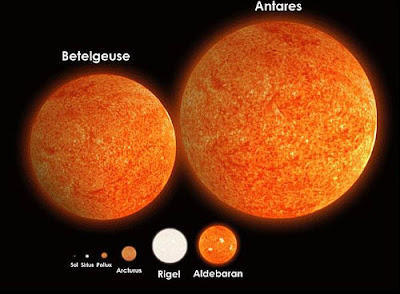
A star is never a ball of gas (mostly hydrogen), whose heart was so warm that it takes place in nuclear fusion reactions. Its spherical shape is the result of a delicate balance: internal reactions tend to enlarge the star (logic: it is a permanent H-bomb) while the force of gravity tends the star to collapse on itself. Hydrogen fuel life of the star, is not eternal. After a moment, the source dries up, and reactions at the heart of the star decreases. The gravitational force takes over, and the heart collapses on itself, thus releasing enormous energy and pushes the envelope of the star, which grows. Growing up it cools (since the same amount of energy radiates through a much larger surface). It becomes a red giant, and its size can reach gigantic proportions. [In the picture below, the Sun is the lowest point on the lower left Betelgeuse]
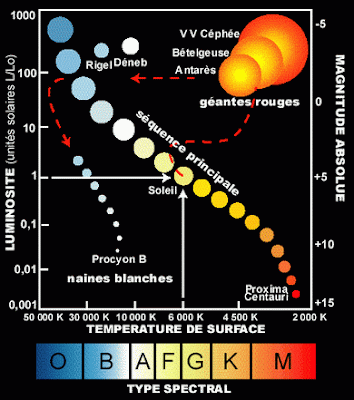 stars evolve so throughout their lives. We can therefore infer from the observation of a star on the stage where it is located. The diagram shows these stages cons in the lives of stars. For much of his life, Betelgeuse was in the "main sequence", it is now out to become a red giant, the last step before the supernova explosion ...
Plus a big star is, the shorter it lives. Alpha Orionis is a big star, about 20 solar masses and ten million years (The Sun 4.6 billion years). It is estimated that Betelgeuse is expected to explode as a supernova within the next 100 millennia. Expect the event to December 21, 2012 is as risky as debt by planning to win the lottery ...
Supernova
is called "Supernova" all the phenomena that occur during the explosion of a massive star (this concerns only the stars at least a dozen solar masses) . As we have seen, a dying star swells as his heart breaks slowly, releasing energy that pushes the layers external. There comes a time when the nuclear reaction is not at all sufficient to prevent a total collapse of the heart due to the gravity of the star. This collapse suddenly stops when the density of the heart is maximal, and the outer layers of the star, who fell at high speed toward the center of the star, bouncing hard on the heart collapsed dense. The shock wave that follows completely disrupts the star. The explosion is accompanied by a sudden and dramatic increase in brightness. The resulting stellar corpse is none other than the core collapse laid bare. It can be a star neutron, a pulsar or a black hole, depending on the mass of the star (Betelgeuse is estimated that should give a black hole). The density of these objects is enormous: one billion tons per cubic centimeter for ...
 This is one of the rarest and energy of the universe. Two examples of image to convince you. Ci-cons, the supernova SN1994D (a bright spot in the bottom left of image). The star that exploded is located in one of the outer arms of the galaxy NGC4526, located more than 50 million light years. It is quite incapable of seeing the stars of a galaxy as distant (they blend into a white halo), but the brightness of a supernova is such that one can see from afar.
The Crab Nebula (below) is located in our galaxy, at 6300 light years from Earth. It's not a supernova but a supernova remnant, that is to say that the explosion went for several centuries. And we just traces in the history of the passage of the supernova: Far East astronomers have observed between 1054 and 1056. The light was so clear that the phenomenon was visible in daylight for almost two years!

The explosion of Betelgeuse would undoubtedly be a particularly visible on Earth. Not to the point of creating a "second sun", but still impressive. The supernova would appear far brighter than Venus and was visible in daylight for a few weeks but would not endanger the Earth or its occupants. The stream of particles discharged (neutrinos) are safe for us: they pass through matter without interacting with almost. And other cosmic radiation emitted would be too weak to pose a threat.
A supernova within 20 light years could be dangerous. Betelgeuse is too far, and its explosion is absolutely not a certainty in the short term. No cause for alarm ...

You might recognize this landscape: the desert, lit by two suns, through which a future Jedi ... We're on Tatooine. And that's what Earth might look like the sky in 2012 from the Australian site news.com.au. The phenomenon is responsible for Betelgeuse, a red giant star is well known in the Northern Hemisphere as it is the brightest of the constellation Orion. But what would really happen if it exploded ...
Betelgeuse

A star is never a ball of gas (mostly hydrogen), whose heart was so warm that it takes place in nuclear fusion reactions. Its spherical shape is the result of a delicate balance: internal reactions tend to enlarge the star (logic: it is a permanent H-bomb) while the force of gravity tends the star to collapse on itself. Hydrogen fuel life of the star, is not eternal. After a moment, the source dries up, and reactions at the heart of the star decreases. The gravitational force takes over, and the heart collapses on itself, thus releasing enormous energy and pushes the envelope of the star, which grows. Growing up it cools (since the same amount of energy radiates through a much larger surface). It becomes a red giant, and its size can reach gigantic proportions. [In the picture below, the Sun is the lowest point on the lower left Betelgeuse]


Plus a big star is, the shorter it lives. Alpha Orionis is a big star, about 20 solar masses and ten million years (The Sun 4.6 billion years). It is estimated that Betelgeuse is expected to explode as a supernova within the next 100 millennia. Expect the event to December 21, 2012 is as risky as debt by planning to win the lottery ...
Supernova
is called "Supernova" all the phenomena that occur during the explosion of a massive star (this concerns only the stars at least a dozen solar masses) . As we have seen, a dying star swells as his heart breaks slowly, releasing energy that pushes the layers external. There comes a time when the nuclear reaction is not at all sufficient to prevent a total collapse of the heart due to the gravity of the star. This collapse suddenly stops when the density of the heart is maximal, and the outer layers of the star, who fell at high speed toward the center of the star, bouncing hard on the heart collapsed dense. The shock wave that follows completely disrupts the star. The explosion is accompanied by a sudden and dramatic increase in brightness. The resulting stellar corpse is none other than the core collapse laid bare. It can be a star neutron, a pulsar or a black hole, depending on the mass of the star (Betelgeuse is estimated that should give a black hole). The density of these objects is enormous: one billion tons per cubic centimeter for ...

The Crab Nebula (below) is located in our galaxy, at 6300 light years from Earth. It's not a supernova but a supernova remnant, that is to say that the explosion went for several centuries. And we just traces in the history of the passage of the supernova: Far East astronomers have observed between 1054 and 1056. The light was so clear that the phenomenon was visible in daylight for almost two years!

The explosion of Betelgeuse would undoubtedly be a particularly visible on Earth. Not to the point of creating a "second sun", but still impressive. The supernova would appear far brighter than Venus and was visible in daylight for a few weeks but would not endanger the Earth or its occupants. The stream of particles discharged (neutrinos) are safe for us: they pass through matter without interacting with almost. And other cosmic radiation emitted would be too weak to pose a threat.
A supernova within 20 light years could be dangerous. Betelgeuse is too far, and its explosion is absolutely not a certainty in the short term. No cause for alarm ...


0 comments:
Post a Comment