land for sale on Mare-Gaillard Gosier, beautiful open view of countryside, small sea view 1350 m2, cos 0.3, 107 € / m2 ... More information Cherchannonces.com
In the heart of Marrakech and in one of the most beautiful areas of Marrakech (wintering), located in a luxury residence at ... More information Cherchannonces.com
redonda, altea, costa blanca, Spain Spacious 4 bed villa
This beautiful English style villa was Is Located In The Sierra corner plot of Altea, close to the Don Cayo golf course .... More information Cherchannonces.com
Spacious 4 bed 2 bath detached villa was 360m2 plot with private pool Located close to La Marquesa golf course, Quesada, Costa ... More information Cherchannonces.com
For rent 50 km from Alicante, a beautiful apartment for the year in residential house, furnished and fully renovated, including 3 bedrooms. Sleeps ... More information Cherchannonces.com
starting to sell because: - 1 class A refrigerator brand FAR (NoFrost) -1 class A washing machine brand FAR - 1 -1 small office cherry bed .. . More information Cherchannonces.com
Discovery, neutron stars, solar flares and space rendezvous
Again, these last few days have been responsible for space news. Nothing better to digest it all a little abstract. Here it is.
the agenda this week: the most powerful solar flare last 4 years, securing the ATC-2 to the International Space Station, the discovery of superfluid in the heart of a neutron star, and off - the last time - the U.S. shuttle Discovery.
The Sun erupting
It there is a classification for solar flares: A, B, C, M and X, each class comprising 10 levels. And February 15, X2 rash occurs on the Sun: the strongest in four years. It is headed toward Earth. The Solar Dynamics Observatory, a NASA satellite has captured the following images:
This eruption had effects on Earth, including China. Three days after the eruption, radio communications are scrambled in southern China, GPS navigation is made a bit more random, while that for the storm magnetic, which lasted a little over a day.
The eruption also has its good sides: the aurora borealis (the image on the right is recent, it is the last solar flare).
Okay, now remains to explain what happened. To understand the mechanism of a solar flare, we must look to the huge magnetic forces that cross the Sun. In some areas, the magnetic field is so intense that it inhibits convection (movement of material in the star that "broadcast" the energy of the star). The consequence is that the surface temperature in this zone decreases, and there is what is called a sunspot. [The eruption of this week is related to a sunspot the size of Jupiter.]
And then, without warning, the magnetic field eventually move and release all the energy that has accumulated in the sunspot . Result: a solar flare, more or less powerful. In extreme cases, there may be mass ejection, this is called a CME (Coronal Mass Ejection). This phenomenon, linked to the solar wind, which can affect Earth.
We fear this kind of event when it is directly facing the Earth. Most of the time, it is observed by the technique of coronary angiography (above). That is to say that the solar disk cache to see what is happening around. Logically, therefore, can not see and the GCE oriented perpendicular to the axis Earth-Sun.
But I was just telling you there is little the U.S. mission to observe the Sun STEREO. Two satellites observe the star from remote positions on the Earth's orbit around the Sun (the cons, satellite position STEREO January 31, 2011). It was therefore able to obtain images by the eruption of coronary directed toward Earth. They are:
In this video, the Earth is right, right in the path of this large CME happened to us in the mouth a few days later.
A neutron star full of superfluid
Two teams of researchers are keenly interested in Cassiopeia A, a supernova remnant located 11,000 light years from Earth in the constellation Cassiopeia. A massive star was there centuries ago. It exploded as a supernova about 330 years ago (as was yesterday), and the stellar corpse is a neutron star. Here is an image taken by NASA's Space Telescope Chandra X:
The stellar corpses have a feature in common: they are extremely dense. In a neutron star, the density and pressure are such that protons and electrons merge and form neutrons. A teaspoon of this substance (called "degenerate") weighs a few billion tons ...
The researchers observed a decrease in "brutal" (4% in 10 years) the temperature of the star. They sought to explain this cooling and reached the following conclusion: the heart of the neutron star must be made of matter "superfluid". Collapsing in on itself, the heart generates "neutrino" that escape from the star, taking with them the energy, and thus cool a bit. Ultra-dense matter that remains then behaves like a superfluid.
superfluid matter known on Earth, we know create it by experience, but under quite different cooling of matter near absolute zero (-273 °). Liquid helium is then in a state without any friction, and has remarkable properties: it is particularly capable of rising walls or escape from an enclosed ...
In the heart of the neutron star, it is far, far away from terrestrial conditions for producing superfluid ... The temperature is approaching the billion degrees. Under these conditions, the strong nuclear force (which binds the nucleons together to form the atomic nucleus) takes over. This
found no consequences in smacking practice, certainly, but it can better understand the behavior of matter degenerate (super heavy) and of superfluids ...
Kepler ISS
After a week of travel in orbit around the Earth, the European ATV cargo spacecraft named the second, named Johannes Kepler, docked Thursday at the International Space Station. As its name suggests, the Automated Transfer Vehicle has performed the operation automatically (under the anxious eyes of a hundred engineers, anyway). Most fans can relive that moment in video (caution, it lacks pace ...):
The ship's mission will last three months. His duties on board the ISS resupply, trash (and yes, it takes), and motor. Regularly, the large structure the ISS loses some altitude in its orbit, and it must improve. The ATC-2 reserve a little of its engines to give a boost when needed.
Last takeoff for Discovery
We seem to hear very regularly about the end of the space shuttle program U.S.. That's because Americans have a little trouble to abandon their ships, and eventually crack and re-sign for a spin. Discovery, which has already passed thirty missions since August 30, 1984, took off last Thursday when the ATV docked with the ISS.
STS-133 carries on the ISS Robonaut 2, final fantasy NASA: it is a humanoid robot (no legs) to be the first permanent member of the crew of the ISS. His role on board will assist astronauts in sensitive missions, including for spacewalks. It should reduce enormously the risk of casualties.
Halfway between horror and science fiction turnip, here's Robonaut. Go Robonaut, say hello to the readers.
Liftoff of Ariane seen the International Space Station
The Ariane 5 rocket, which carries the cargo spacecraft ATV-2 Johannes Kepler to the ISS, finally took off yesterday evening (around 23 noon, French, 18 hours at Kourou). Liftoff, scheduled for Feb. 15, has been delayed one day by security (problems related measures liquid oxygen tank). Injection orbit successfully, and the ATC-2 has a long road ahead of a week in orbit to catch up gradually the station.
The rocket launch is always an impressive event to see, and not from the ground. Here is a photo taken yesterday by the European astronaut Paolo Nespoli, himself aboard the station.
I talked about yesterday's visit of the comet Tempel 1 by the U.S. Stardust probe, and the imminent departure of the 200th Ariane 5 rocket. New fallen since yesterday afternoon. Here they are.
First, by talking about Tempel, I could provide you a photo taken during the approach to nearly 2000 km of the object. Well here's comet seen by Stardust during its passage within 200 kilometers (click image to enlarge):
The researchers hoped to find on these pictures the impact crater caused by the Deep Impact spacecraft in 2005. It is less obvious to detect than expected, the soil having been shaped by final passage of the comet near the sun. But it is there. By cons, apart from being a scientist used to study what kind of shots, you can not see the crater ...
On the picture cons, the crater is marked by a yellow circle. Surprisingly, the fuzzier the picture (right) is the latest taken by Stardust, while the other date of the Deep Impact mission. But the dust immediately after impact (hard to see here as the scale is small) had made observations difficult here.
But
Astronomers are confident, and it appears that the crater is 150 meters in diameter, and it includes a small mound in the middle (it means the material ejected during the impact fell on the comet).
The shots continue to be shelled for weeks. The game will now compare the images taken by Deep Impact and Stardust by those taken in the hope of finding differences due to the last passage of the comet near the sun. (The cons: Deep Impact left Stardust right).
And finally on Tempel-1, here is a little video compiled by Ian O'Neill, astrophysicist blogger for Discovery News. With the pictures from Stardust, we relive the passage of the probe near the comet.
Liftoff of Ariane 5 postponed tonight
The 200th Ariane rocket (which calculates takes into account the old version of Ariane, the Ariane 5 model, he has stolen some sixty times) was off last night, but the countdown has stopped 4 minutes and 1 second before firing. The cause: an abnormality in the measures related to liquid oxygen tank in the cryogenic stage of the rocket. Liftoff is now scheduled for tonight at 22:50 CET (French time), 6:50 p.m. local time in Kourou, French Guiana.
say they expected a delay, it would be bad language, but it's still somewhat true. In the field, the delays are legion. Arianespace but prefers to take precautions, even multiply times. Result: Ariane rocket is one of the most reliable in the world, and has a success rate of 95% since 1979.
The new attempt may be viewed live here . The page offers a short documentary pending CNES on the ATV.
lot of space news this week, and so little time talking to you! Here, in a single post, a summary (just explained) of the week ...
Three events that attract attention sermaine: visiting the Comet Tempel 1, the advance of the STEREO mission, which aims to observe the sun from two points of view, and the launch tonight, the second Automated Transfer Vehicle for the European Space Agency: Johannes Kepler.
There is another "big news" space which I will not speak here. And yet, it pours ink and place of the coil even while we're on the national news: the Mars 500 has reached its peak, three false astronauts set foot on Mars false. I will not, simply because it does not happen in space and science in question is more psychological and medical qu'astrophysique. If you still want to know more, here are two links, in English and in French .
visit the temple
And the star of the week, Tempel 1. This stone is actually a celestial comet, that is to say that he regularly approached close enough sunlight to his heart full of water starts to melt, which reveals a streak across the sky.
In 2005, the comet had been visited by Deep Impact (the picture cons date of this mission), a probe on behalf of bad disaster movie that deliberately crashed an impactor on its surface. This object crashed at high speed (over 36 000 km / h) and has created a large crater 30 meters in diameter, poetically called Deep Impact. We would have liked to dissect the time images of the surface torn by the impact. It would have given a lot of information, particularly on the internal composition of the comet. Just bad luck, the picture was bad.
But NASA does not stop this kind of disappointment. When we budget, we can multiply missions. And a second probe, called Stardust, is sent out to take a second look (this is not the first mission of Stardust probe launched in 1999 and has had time to collect samples from the tail of Comet Wild 2 and return them to Earth). The meeting took place on 14 February, which resulted in a deluge of easy comparisons with Valentine's Day.
What is expected of this mission is of course first of many great pictures. The meeting has taken place, the probe passed within 200 kilometers of its target, but at this writing the images are being transferred. The only photo currently available was taken over 2000 kilometers of Tempel. Here it is:
Other images should be disclosed in the afternoon. Here is a link that allows you to follow live their reception: http://www.ustream.tv/nasajpl2 .
The observation of a comet in two steps is a first. Between Deep Impact and Stardust, Tempel had time to approach the sun. Stardust's visit should allow us to learn more about what has changed between time and also take a look at the crater that Deep Impact will tell volumes about the internal structure of the comet. The study of these stars is important since they are considered "fossil" of the early solar system. The story of Stardust, meanwhile, is nearing the end: the probe has more fuel, it will soon change its path and get lost in a long heliocentric orbit (around the sun).
The sun in STEREO
's another week of news that deserves to be interested. Americans (still) have finally managed to get a 3D image of the sun, sending two satellites on both sides of the comet. Here is one result of this mission: the first image of the "dark side" of the sun.
The mission will focus primarily on the study of CME (Coronal Mass Ejection). The solar corona ("atmosphere" of the sun, even hotter than its surface) regularly ejects large amounts of material that strike the Earth in the form of solar wind. This causes the aurora borealis, but also destructive: blackout satellites, radiation astronauts in orbit, disruption of radio communications ... Hence the interest of seeking to predict these phenomena.
As you can see in the image below-cons, you have to study the solar corona put a cover over the lens of the telescope to block the sunlight itself. CMEs that are observed are headed in a direction perpendicular to the Sun-Earth axis. To predict which CMEs will affect us, the only solution is to get to another point, to observe the Sun from a distant position on the Earth's orbit. It is the goal of the STEREO mission.
The two small U.S. satellites have moved away gradually from the earth, one in front and one backward in its orbit around the sun. In early February, the probes were well on both sides of our planet, hence the announcement. Eventually, the two satellites will cross "behind" the sun, then will re-turn before ending up at the Earth in a dozen years. The trajectory is complicated, and reports to the challenge to astronomers:
Last but not least
Here, finally, last "big" new space week The launch tonight, the second of ESA's ATV, named Johannes Kepler. Launched by the 200th Ariane rocket, the spaceship freighter should reach the ISS by the end of the month.
Needless to return the ATV that I have already described in a recent post . Remember it will take just 7 tons of cargo (food, fuel, water, various stuff ...) on the International Space Station, its mooring is completely automated, and European space industry is very proud of its technological marvel . One can even say that it is clearly the showcase of European industry in the area.
The Ariane rocket should be launched this evening, about 23 hours. The ATV will detach it 63 minutes after launch, and then continue its route to the station.
(the picture is recent cons, it is indeed responsible for the rocket Ariane 5 ATV Kepler, ready for departure).
NASA has finally unveiled the results of its scientific Kepler space telescope. The researcher observed exoplanets a little corner of heaven populated by about 150 000 stars in the constellation Cygnus. Since he began his mission in March 2009, Kepler has isolated a large thousand planets "candidates." What revolutionize the search for exoplanets.
before yesterday, 525 were known exoplanets. Kepler in 1235 announced new potential. So of course, well supplied in this package, we hope to find the Grail of exoplanets: one that looks like the Earth and orbiting in the habitable zone of its star. And Kepler already announced five candidates. Candidates only, because observing planets around other stars is a challenging task and the false positive results are common.
Monitoring Methods
There are plenty of ways to detect extrasolar planets, but most of them are examined by two methods: the astronomical transits and the radial velocity. The two are complementary, you'll understand why.
When a planet passes between us and its star, it partially obscures and diminishes its luminosity for a while.
If we know the magnitude (brightness) of the star, and we managed to measure fairly accurately decrease caused by the passage of the planet, we can deduce its size: the more it obscures the light from its star, the more she is pregnant. In the image-cons, most dug curves correspond to the largest planets. To be sure this is a planet, it must pass before the star at regular intervals. By knowing the frequency of passage, it follows its orbital period (the time it takes to go around its star at home 1 year).
The method has drawbacks ... The drop in brightness caused by the passage of the planet is very low: about 1%. Researchers are therefore forced to develop highly sensitive instruments, and especially to make them safe from disturbance. Kepler is well away from light land in Lagrange point L2 to 1.5 million kilometers from Earth.
Another drawback: you can not detect planetary systems if they are seen edge-on. This is the only configuration in which one can "see" a planet passing in front of its star.
And then with this method, we finally knows little about the planet discovered (size ...). Therefore we associate a second approach: that a little more complex radial velocity.
A planet orbiting its star flips on itself. A picture commonly used to explain this phenomenon is the putter that turns on itself: it varies also because of the mass of his weight. In physical terms, we say that the centroid of the athlete-weight system (star-planet) is slightly offset from the center of the star.
Now that we know this, it is to detect it. Oscillating, the star away and getting closer to us. These movements are detectable in the electromagnetic spectrum of the star through the Doppler effect. The sound of the ambulance appears more acute if it is approaching us, and worse if it goes away. These sound waves are compressed when the vehicle is approaching that cause this effect. The same phenomenon is reflected in the electromagnetic spectrum by a shift of the spectrum of the star to the blue if she approaches, and to red if it walks away.
In this method we can deduce the period of revolution and the mass of the star: the higher it is, the more the oscillations are profound. The comparison of the mass and size of the planet gives us the density, we can know whether it is gas or LBS.
Now that we know the methods used can explain the concept of "candidates". For all exoplanets announced by Kepler still bear this title unflattering. The fact is that there is not a planet can occult a star. Some stars, for example, do not change but only form of dual systems. And Kepler's observations, they are all accurate, are not dédnuées "noise" that the parasite can lead to results and results erroneous. Impossible to estimate the proportion of false-positive without having any idea how many exoplanets ...
The Holy Grail
Nevertheless the Holy Grail Astronomical can begin, and the numbers are promising. Of the more than 1,200 candidates, 68 have a size comparable to Earth, and 54 (of 1200) are in the habitable zone of their star. Those that interest us are comparable in size and are in the habitable zone. They are 5 potential.
In this area, we should not declare victory too soon. A few weeks ago the announcement slightly precipitated the discovery of Gliese 581c in the habitable zone of its star was quickly challenged . This is why hundreds of scientists and almost as many telescopes will consider these results to test and possibly confirm.
Given the smallness of the area studied by Kepler (image), who observed that part of the sky in the constellation Cygnus, the hopes of finding "exo-Earth" is great ...
An unusual system
Another element that stands out in these results and I have not yet mentioned: the planetary system that accompanies the star Kepler-11. Know ahead as the stars do not usually have more than one planet. Kepler still found 170 potential complete systems, but the famous K-11 and raises many questions.
It is comprised of 6 planets, 5 of them among the smallest exoplanet ever discovered. But the most curious is that all these planets are in orbits very gathered around their star. In the solar system, 5 of the 6 planets orbiting between Mercury and the Sun. Another curiosity: this system is almost perfectly flat.
2012 and its flood of rumors apocalyptic have spilled much ink. Since the turnip Roland Emmerich, the assumptions is mounting destructive volcanic activity, Earth's magnetic field reversal ... Latest: the explosion "expected" of Betelgeuse supernova, the Apocalypse from the sky. A misconception that I will gladly remove.
You might recognize this landscape: the desert, lit by two suns, through which a future Jedi ... We're on Tatooine. And that's what Earth might look like the sky in 2012 from the Australian site news.com.au. The phenomenon is responsible for Betelgeuse, a red giant star is well known in the Northern Hemisphere as it is the brightest of the constellation Orion. But what would really happen if it exploded ...
Betelgeuse
Betelgeuse, it's her. We do know that approximately the distance relative to the sun (its dusty makes any certain estimate): ~ 600 light years. From Earth, Alpha Orionis (its pretentious name) appears as a reddish star, and for good reason: it is a red supergiant. Explanations.
A star is never a ball of gas (mostly hydrogen), whose heart was so warm that it takes place in nuclear fusion reactions. Its spherical shape is the result of a delicate balance: internal reactions tend to enlarge the star (logic: it is a permanent H-bomb) while the force of gravity tends the star to collapse on itself. Hydrogen fuel life of the star, is not eternal. After a moment, the source dries up, and reactions at the heart of the star decreases. The gravitational force takes over, and the heart collapses on itself, thus releasing enormous energy and pushes the envelope of the star, which grows. Growing up it cools (since the same amount of energy radiates through a much larger surface). It becomes a red giant, and its size can reach gigantic proportions. [In the picture below, the Sun is the lowest point on the lower left Betelgeuse]
stars evolve so throughout their lives. We can therefore infer from the observation of a star on the stage where it is located. The diagram shows these stages cons in the lives of stars. For much of his life, Betelgeuse was in the "main sequence", it is now out to become a red giant, the last step before the supernova explosion ...
Plus a big star is, the shorter it lives. Alpha Orionis is a big star, about 20 solar masses and ten million years (The Sun 4.6 billion years). It is estimated that Betelgeuse is expected to explode as a supernova within the next 100 millennia. Expect the event to December 21, 2012 is as risky as debt by planning to win the lottery ...
Supernova
is called "Supernova" all the phenomena that occur during the explosion of a massive star (this concerns only the stars at least a dozen solar masses) . As we have seen, a dying star swells as his heart breaks slowly, releasing energy that pushes the layers external. There comes a time when the nuclear reaction is not at all sufficient to prevent a total collapse of the heart due to the gravity of the star. This collapse suddenly stops when the density of the heart is maximal, and the outer layers of the star, who fell at high speed toward the center of the star, bouncing hard on the heart collapsed dense. The shock wave that follows completely disrupts the star. The explosion is accompanied by a sudden and dramatic increase in brightness. The resulting stellar corpse is none other than the core collapse laid bare. It can be a star neutron, a pulsar or a black hole, depending on the mass of the star (Betelgeuse is estimated that should give a black hole). The density of these objects is enormous: one billion tons per cubic centimeter for ...
This is one of the rarest and energy of the universe. Two examples of image to convince you. Ci-cons, the supernova SN1994D (a bright spot in the bottom left of image). The star that exploded is located in one of the outer arms of the galaxy NGC4526, located more than 50 million light years. It is quite incapable of seeing the stars of a galaxy as distant (they blend into a white halo), but the brightness of a supernova is such that one can see from afar.
The Crab Nebula (below) is located in our galaxy, at 6300 light years from Earth. It's not a supernova but a supernova remnant, that is to say that the explosion went for several centuries. And we just traces in the history of the passage of the supernova: Far East astronomers have observed between 1054 and 1056. The light was so clear that the phenomenon was visible in daylight for almost two years!
The explosion of Betelgeuse would undoubtedly be a particularly visible on Earth. Not to the point of creating a "second sun", but still impressive. The supernova would appear far brighter than Venus and was visible in daylight for a few weeks but would not endanger the Earth or its occupants. The stream of particles discharged (neutrinos) are safe for us: they pass through matter without interacting with almost. And other cosmic radiation emitted would be too weak to pose a threat.
A supernova within 20 light years could be dangerous. Betelgeuse is too far, and its explosion is absolutely not a certainty in the short term. No cause for alarm ...
Jolie than usual this Valentine's Day, from the medieval feast of love. In fact, the Catholic Church had merely, as often, to return an ancient Roman celebration dedicated to the worship of love and fertility. On the calendar, it corresponded to that of Valentine's Day, celebrated on February 24 - it is actually three Christian martyrs celebrated the same day. Since then, it is fitting that a couple of small gifts offered in love, invites himself to spend together on a weekend or a night of dreaming. Love said that also said the cult of Eros and erotic art. Tintin and reluctantly abandon his serial killings to say the best of love. The time of waiting.
"time of waiting, attention, fear delicious. Best time to love. Time of seduction and appearance, when we do not see that in the eyes of others. When we fear the slightest false note. At least that is what feminine behavior ...
Finally, Laure resorts to signal its presence by opening the door of the mini bar.
- Because you want to drink anything, I put everything back in the fridge. I propose that mango juice with a hint of vodka to spice things up.
- Well, Corson!
It takes one of two glasses which she tends. Then he draws a handful of sun-soaked cherries and stands over her, for her to snatch. They clink glasses. Softened by the mango, vodka cache effects, but both want to get carried away by a slight intoxication, in this special moment.
Also, Laura had the impression that these small moments of happiness remaining stolen moments. Ever, it has been able to believe in happiness and said it is probably not good at it. This time, she defends herself to think too far to be carried away by circumstances. No such provision. Decide nothing. He let the initiative, then it has continuously sought to lead and control his life. At that moment, she wants the pleasure of Shan.
- What can I do for you, right now? asked he.
She was grateful not to rush, to also enjoy the wait by not caring that her.
- A foot massage at the Tibetan?
- I am afraid of being incompetent, but I can always try.
- There's a bottle of almond milk on the edge of the sink.
With a sigh of relief, she lies down on the couch - the bed was a little subtle choice. Bathrobe wisely closed, legs spread, she nibbles a cherry and taste his drink. While Debussy continues to roll its waves, she savored the moment. Shan is beautiful, but she is not sure to want to love with him.
It feels too good.
He returns with the milk, looks at her and, slowly, with an excess of caution, pour the cream on her feet, ankles and calves. His hands are soft and experts to take possession of his skin slowly. They graze in, first, then knead it more firmly. Seated against it, Shan watching his approval and this way to explore with confidence his feet and legs seemed suddenly more intimate, more erotic than a hug.
hand back a little and massage begins to look like a caress. Laura also wants to know the skin of a dark grain that contrasts so well with the color of snow bathrobe. Who would be so nice effect against hers. His hand touches the nape of Shan. His fingernails slowly running his flesh, but she resists the temptation to sink his claws. Everything must, for now, be only gently.
- I'll make mistakes, "he said with a chuckle.
Without answering, she draws her. He puts his lips on his cheek and wants to get up, but it is stronger than him. Turning his head, his mouth is and she gives him the kiss s'enfièvre. Laura feels melting from the mouth. Her moist heat attracts like vertigo. With its mysteries and promises. Shan does not yet extend the kiss and stood up, uttered these strange words:
- It is better that I leave you now. Thank you for cherries and vodka with mango.
As he opens the door, she joined him and resumed the interrupted kiss that loads this time of violence. Almost ferocity. He plaque to him and kiss them away. Again, it He stops, as if it incorporated roughly the control of a force having failed to overwhelm.
- I'm going, "he said while waiting for other words.
- A butterfly forages women and do not linger. I've seen during this gala evening. It is true that you foraging females. For your sake? I do not know ... bye, butterfly.
He smiled. A disarming smile who offers or resumes, they do not know, then he closes the door softly without her trying to restrain him. They are after all almost prisoners This city within a city. Even if everything is monstrous, superhuman, they inevitably will cross one day or another.
Now she has to perform his journalistic work and explore the picturesque corners of Singapore, China Town and Little India, the neighborhoods still untouched by the futurism of the vast city. It will also have another purpose. It will be occupied in waiting. "
Going through this little pebble arid the meager crops of cotton, wheat and vegetables than 320 km2, one is struck by the magnificence of its architecture: a profusion of splendid baroque churches, even in the smallest villages, sumptuous palaces but most powerful fortifications, many works of the Knights of St. John arrived here in the sixteenth century. A long and rich history ...
The floor of the Cathedral of St. John is made of tombstones of the Knights
well fortified port of La Valetta
From Christian kingdom of Jerusalem in the execution of Jacques de Molay
When Jerusalem fell to the Crusaders during the First Crusade, July 15, 1099, the wounded were numerous in the ranks of Christian fighters. The Benedictine monks who followed the knights in their journey then erected the first Catholic hospital in Jerusalem, near the Holy Sepulchre. Hospital asserting their vocation, their abbot, Blessed Gerard whom we know in fact not much, then founded the Hospitaller Order of Saint John of Jerusalem to 1113 and became its first Grand Master. Slowly, with growing insecurity, these monks following always the Benedictine rule in turn became fighters, monks, knights to the safety of pilgrims, without losing their vocation hospital. During the Council of Troyes convened in 1129, the pope praised them and said their status. To differentiate itself from other Benedictine monks knights then hoisted their black robes with a cross with eight points, now known as the Maltese Cross.
So far from their European bases, knights and monks, soldiers became very vulnerable, once the momentum of the crusade fell and the small kingdom of Jerusalem well exposed. At the end of June 1187, the Muslim sultan Saladin, while reigning over Egypt and Syria, besieged Jerusalem. The forces were prodigious for the time, knights and more than 1500 16 000 infantrymen from the Christian side, probably double the Muslim side. The siege was long and bloody and Jerusalem fell October 2, 1187. All the knights were executed prisoners. Driven from Jerusalem, the Knights of St. John, who succeeded in escaping regrouped in Acre and founded a new hospital.
Peace had not returned so far between Christians and Muslims. The assault was given in Acre April 5, 1291 and the Knights of St. John had to abandon their new fortress-monastery on May 8 to win the island of Cyprus, where they continued their fight against the Muslims, this time at sea . In 1309, they left Cyprus and moved to the island of Rhodes, easier to defend.
In France, King Philip the Fair, worried about the growing power and wealth of another warrior, the Templars, was arrested Friday, October 13, 1307 all present Knights Templars on French soil and Grand Master Jacques de Molay. It was a shameful trial and falsified, the Templars being unjustly accused of all crimes, including witchcraft and buggery, that is to say, homosexuality. All their possessions were of course forfeited to the crown. Jacques de Molay and Geoffrey of Charney, commander of Normandy, were burned alive in Paris March 18, 1314 by continuing to proclaim their innocence after confessions extracted by torture.
Rendered cautious by this horrible example, and other orders Knights Hospitallers of St. John refrained from returning to their country and entrenched themselves in their various strongholds.
The area in Vittoriosa
And that of Three Cities
The authority of Grandmaster
Born of the First Crusade, the Military and Hospitaller Knights of Saint John welcomed members of the nobility from all the empires and kingdoms of Christendom. To become a member, he should at least prove four quarters of nobility, that is to say, be noble for four generations. Sovereign Order ruled by a Grand Master elected for life by all the knights, the Order of the Knights of St. John was and is still considered a true state. Grandmaster concentrated all powers in his hands as guardian of strict observance of the rule of St. Benedict, director of the immense wealth of the order, each knight on his death bequeathed his estate to his command, master of the general chapter that it convened and chaired by rendering justice and finally military leader of his knights. His reputation for piety and bravery attracting ever many more knights, the order consisted of about four hundred knights during such period of Rhodes.
Auberge de Castille
Everyone belonging to a distinct nationality and speak a different language, although French was long their official language They were grouped by language , living in hostels together all the knights of the same country or, if too many of the same province and charged with the defense military territory where their hostel was situated.
But we should not believe that Knights Hospitallers of St. John remained stationed in Rhodes. As to its growing power, about his commanderies swarmed all over Europe, always under the orders of the Grand Master that he resided in Rhodes.
From their heavily fortified base of Rhodes, the knights and their galleys on the sea constantly harassing the powerful Ottoman ship, so the Sultan Soliman decided to lay siege to the island and arrived June 24, 1522 . After a heroic resistance that lasted six months and forced the admiration of Suleiman, the Grand Master Philippe de l'Isle Adam had to go with his knights. He was given the honors of war, life saving for him and all his people, the right to carry on their galleys all their wealth.
The small fortified town of Victoria
Blue Lagoon, a magical bay
Arrival in Malta and the Great Siege
After seven years of wandering without knowing where to set the Knights of St John were finally given the hands of the Emperor Charles V the free enjoyment of the Maltese archipelago, composed of Malta, Gozo and Comino, the cons of a nominal fee Maltese falcon a year!
When reached Malta in 1530, the knights were generally well received by the people who lived in fear of pirate attacks, less well by the local nobility who guessed the end of its prerogatives. Initially disappointed by the aridity of Island, the Knights quickly realized the strategic importance of the roads to the ten loops that today the port of Valletta and its environs, where they anchored their galleys, while organizing the fortifications of the city of Medina, inland. They then turned their attention from defenses this natural harbor, building the first site of an old fort, the current castle of St. Angelo, and the mighty fort of St. Elmo at the tip of the peninsula separating the two main bays. Finally, extending the current quarter Birgu Vittoriosa they built a hospital and another fort.
Around Fort Comino
Soliman, although older, bitterly regretted having lost their lives saving the Knights defeated and launched two attacks against the order in 1547 and 1551, only managing to take the island of Gozo where all the inhabitants were taken into slavery. The old Sultan regrouped his forces and launched forty-eight thousand of his best soldiers against Malta 18 May 1565. Opposite him, there were only eight thousand men, 540 Knights, 4000 Maltese and mercenaries.
The heroic Jean de la Valette
Grand Master Jean de la Valette, withdrew its troops thin on the fortified places of Medina and the new port. Besieged on all sides, Fort St. Elmo was forced to surrender after a fierce resistance for 31 days. Resistant to all the Turkish attacks in other strongholds, the Knights were able to await the arrival of reinforcements from Sicily who demoralized Ottoman forces and forced them to resume the sea holding the lock Malta, Jean de la Valette and his Knights had saved Christendom and were feted as heroes. Significant financial support came from everywhere and Jean de la Valette was finally able to realize his dream of building a beautiful city that bore his name across the harbor so well defended. Pope Pius IV sent him even his best military architect Francesco Laparelli, who drew the plans for the future town, as it can still be seen today, with its straight streets, its churches and its magnificent palaces, hostels to house the knights. Then, six years after the Great Siege, the sea battle of Lepanto which was attended by the knights and their galleys consumers the Ottoman defeat.
Fort Comino, powerful war machine
With the Ottoman defeat, the Knights gradually lost their warrior mission and softened in luxury, so when Napoleon came to invade Malta in 1798, the German Grand Master Ferdinand von Hompesch, do not resist him. That was because of the supremacy of the Order of St. John in Malta, but the presence of two and a half centuries was the beauty and richness of the island. We owe to the Knights most of the monuments: the stunning Co-Cathedral of St. John, the Grand Masters Palace became a museum of arms, hospices, inns, forts and bunkers, the innumerable churches and convents on the island.


 Okay, now remains to explain what happened. To understand the mechanism of a solar flare, we must look to the huge magnetic forces that cross the Sun. In some areas, the magnetic field is so intense that it inhibits convection (movement of material in the star that "broadcast" the energy of the star). The consequence is that the surface temperature in this zone decreases, and there is what is called a sunspot. [The eruption of this week is related to a sunspot the size of Jupiter.]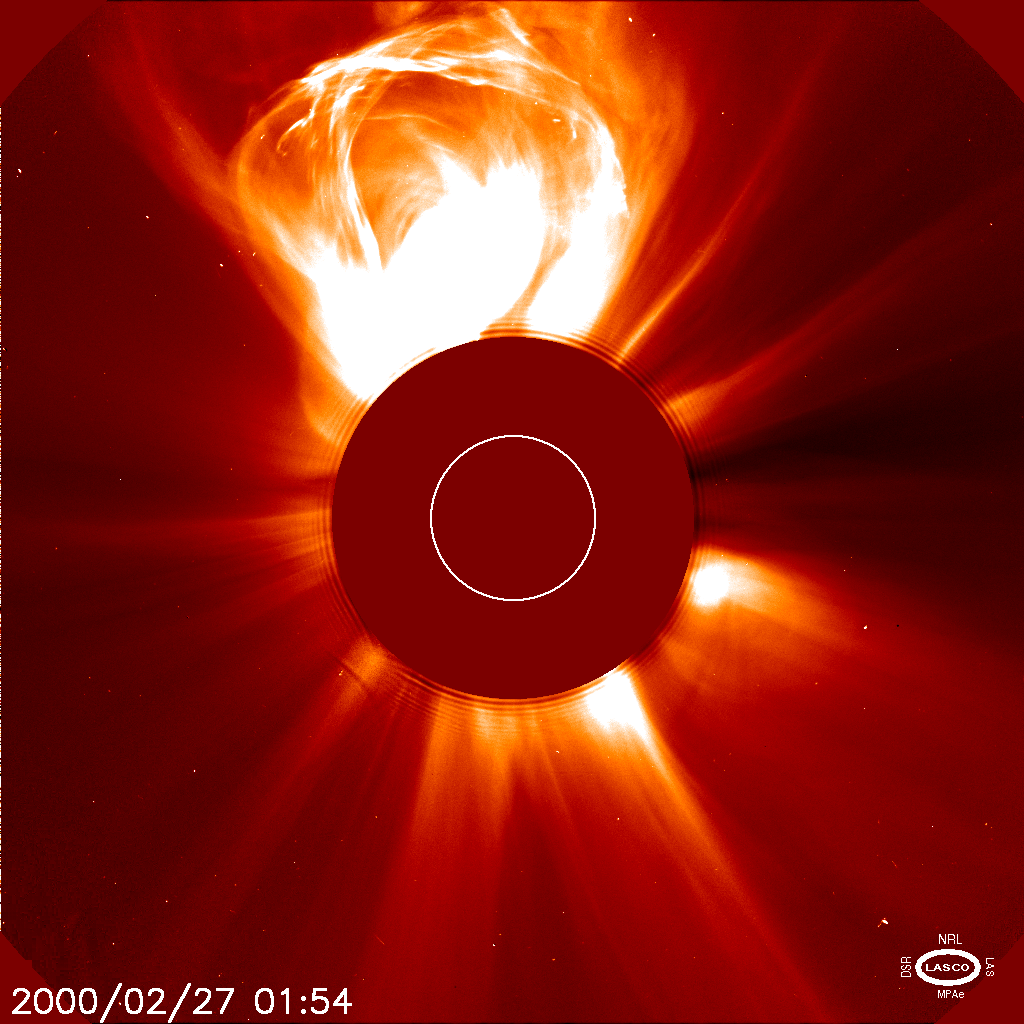
 We fear this kind of event when it is directly facing the Earth. Most of the time, it is observed by the technique of coronary angiography (above). That is to say that the solar disk cache to see what is happening around. Logically, therefore, can not see and the GCE oriented perpendicular to the axis Earth-Sun.
 Last takeoff for Discovery


 When a planet passes between us and its star, it partially obscures and diminishes its luminosity for a while.
 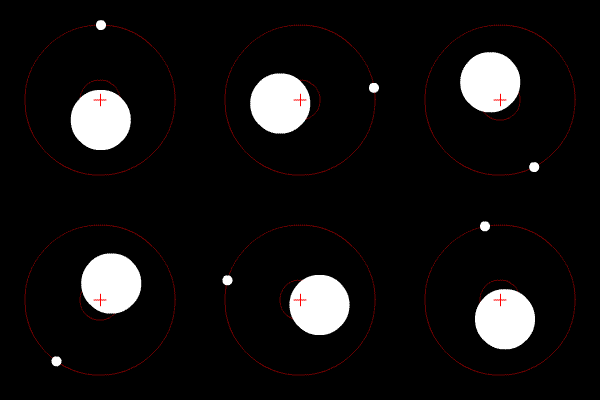 A planet orbiting its star flips on itself. A picture commonly used to explain this phenomenon is the putter that turns on itself: it varies also because of the mass of his weight. In physical terms, we say that the centroid of the athlete-weight system (star-planet) is slightly offset from the center of the star.
  Now that we know this, it is to detect it. Oscillating, the star away and getting closer to us. These movements are detectable in the electromagnetic spectrum of the star through the Doppler effect. The sound of the ambulance appears more acute if it is approaching us, and worse if it goes away. These sound waves are compressed when the vehicle is approaching that cause this effect. The same phenomenon is reflected in the electromagnetic spectrum by a shift of the spectrum of the star to the blue if she approaches, and to red if it walks away.


