NASA has finally unveiled the results of its scientific Kepler space telescope. The researcher observed exoplanets a little corner of heaven populated by about 150 000 stars in the constellation Cygnus. Since he began his mission in March 2009, Kepler has isolated a large thousand planets "candidates." What revolutionize the search for exoplanets.

before yesterday, 525 were known exoplanets. Kepler in 1235 announced new potential. So of course, well supplied in this package, we hope to find the Grail of exoplanets: one that looks like the Earth and orbiting in the habitable zone of its star. And Kepler already announced five candidates. Candidates only, because observing planets around other stars is a challenging task and the false positive results are common.
Monitoring Methods
There are plenty of ways to detect extrasolar planets, but most of them are examined by two methods: the astronomical transits and the radial velocity. The two are complementary, you'll understand why.
 When a planet passes between us and its star, it partially obscures and diminishes its luminosity for a while.
 If we know the magnitude (brightness) of the star, and we managed to measure fairly accurately decrease caused by the passage of the planet, we can deduce its size: the more it obscures the light from its star, the more she is pregnant. In the image-cons, most dug curves correspond to the largest planets. To be sure this is a planet, it must pass before the star at regular intervals. By knowing the frequency of passage, it follows its orbital period (the time it takes to go around its star at home 1 year).
The method has drawbacks ... The drop in brightness caused by the passage of the planet is very low: about 1%. Researchers are therefore forced to develop highly sensitive instruments, and especially to make them safe from disturbance. Kepler is well away from light land in Lagrange point L2 to 1.5 million kilometers from Earth.
Another drawback: you can not detect planetary systems if they are seen edge-on. This is the only configuration in which one can "see" a planet passing in front of its star.
And then with this method, we finally knows little about the planet discovered (size ...). Therefore we associate a second approach: that a little more complex radial velocity.
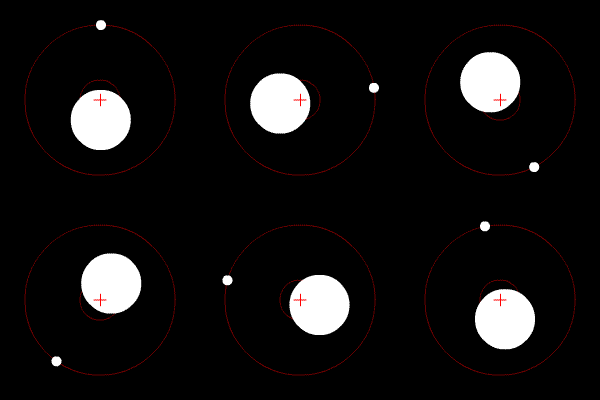 A planet orbiting its star flips on itself. A picture commonly used to explain this phenomenon is the putter that turns on itself: it varies also because of the mass of his weight. In physical terms, we say that the centroid of the athlete-weight system (star-planet) is slightly offset from the center of the star.
 Now that we know this, it is to detect it. Oscillating, the star away and getting closer to us. These movements are detectable in the electromagnetic spectrum of the star through the Doppler effect. The sound of the ambulance appears more acute if it is approaching us, and worse if it goes away. These sound waves are compressed when the vehicle is approaching that cause this effect. The same phenomenon is reflected in the electromagnetic spectrum by a shift of the spectrum of the star to the blue if she approaches, and to red if it walks away.
In this method we can deduce the period of revolution and the mass of the star: the higher it is, the more the oscillations are profound. The comparison of the mass and size of the planet gives us the density, we can know whether it is gas or LBS.
Now that we know the methods used can explain the concept of "candidates". For all exoplanets announced by Kepler still bear this title unflattering. The fact is that there is not a planet can occult a star. Some stars, for example, do not change but only form of dual systems. And Kepler's observations, they are all accurate, are not dédnuées "noise" that the parasite can lead to results and results erroneous. Impossible to estimate the proportion of false-positive without having any idea how many exoplanets ...
The Holy Grail
 Nevertheless the Holy Grail Astronomical can begin, and the numbers are promising. Of the more than 1,200 candidates, 68 have a size comparable to Earth, and 54 (of 1200) are in the habitable zone of their star. Those that interest us are comparable in size and are in the habitable zone. They are 5 potential.
In this area, we should not declare victory too soon. A few weeks ago the announcement slightly precipitated the discovery of Gliese 581c in the habitable zone of its star was quickly challenged . This is why hundreds of scientists and almost as many telescopes will consider these results to test and possibly confirm.
Given the smallness of the area studied by Kepler (image), who observed that part of the sky in the constellation Cygnus, the hopes of finding "exo-Earth" is great ...
An unusual system
Another element that stands out in these results and I have not yet mentioned: the planetary system that accompanies the star Kepler-11. Know ahead as the stars do not usually have more than one planet. Kepler still found 170 potential complete systems, but the famous K-11 and raises many questions.
It is comprised of 6 planets, 5 of them among the smallest exoplanet ever discovered. But the most curious is that all these planets are in orbits very gathered around their star. In the solar system, 5 of the 6 planets orbiting between Mercury and the Sun. Another curiosity: this system is almost perfectly flat.
Link
Official site of the Kepler Mission: http://kepler.nasa.gov/
 A planet orbiting its star flips on itself. A picture commonly used to explain this phenomenon is the putter that turns on itself: it varies also because of the mass of his weight. In physical terms, we say that the centroid of the athlete-weight system (star-planet) is slightly offset from the center of the star.
  Now that we know this, it is to detect it. Oscillating, the star away and getting closer to us. These movements are detectable in the electromagnetic spectrum of the star through the Doppler effect. The sound of the ambulance appears more acute if it is approaching us, and worse if it goes away. These sound waves are compressed when the vehicle is approaching that cause this effect. The same phenomenon is reflected in the electromagnetic spectrum by a shift of the spectrum of the star to the blue if she approaches, and to red if it walks away.
 In this method we can deduce the period of revolution and the mass of the star: the higher it is, the more the oscillations are profound. The comparison of the mass and size of the planet gives us the density, we can know whether it is gas or LBS.
Now that we know the methods used can explain the concept of "candidates". For all exoplanets announced by Kepler still bear this title unflattering. The fact is that there is not a planet can occult a star. Some stars, for example, do not change but only form of dual systems. And Kepler's observations, they are all accurate, are not dédnuées "noise" that the parasite can lead to results and results erroneous. Impossible to estimate the proportion of false-positive without having any idea how many exoplanets ...
The Holy Grail

In this area, we should not declare victory too soon. A few weeks ago the announcement slightly precipitated the discovery of Gliese 581c in the habitable zone of its star was quickly challenged . This is why hundreds of scientists and almost as many telescopes will consider these results to test and possibly confirm.
Given the smallness of the area studied by Kepler (image), who observed that part of the sky in the constellation Cygnus, the hopes of finding "exo-Earth" is great ...
An unusual system
Another element that stands out in these results and I have not yet mentioned: the planetary system that accompanies the star Kepler-11. Know ahead as the stars do not usually have more than one planet. Kepler still found 170 potential complete systems, but the famous K-11 and raises many questions.
It is comprised of 6 planets, 5 of them among the smallest exoplanet ever discovered. But the most curious is that all these planets are in orbits very gathered around their star. In the solar system, 5 of the 6 planets orbiting between Mercury and the Sun. Another curiosity: this system is almost perfectly flat.
Link
Official site of the Kepler Mission: http://kepler.nasa.gov/


0 comments:
Post a Comment