Again, these last few days have been responsible for space news. Nothing better to digest it all a little abstract. Here it is.
the agenda this week: the most powerful solar flare last 4 years, securing the ATC-2 to the International Space Station, the discovery of superfluid in the heart of a neutron star, and off - the last time - the U.S. shuttle Discovery.
The Sun erupting
It there is a classification for solar flares: A, B, C, M and X, each class comprising 10 levels. And February 15, X2 rash occurs on the Sun: the strongest in four years. It is headed toward Earth. The Solar Dynamics Observatory, a NASA satellite has captured the following images:

The eruption also has its good sides: the aurora borealis (the image on the right is recent, it is the last solar flare).
 Okay, now remains to explain what happened. To understand the mechanism of a solar flare, we must look to the huge magnetic forces that cross the Sun. In some areas, the magnetic field is so intense that it inhibits convection (movement of material in the star that "broadcast" the energy of the star). The consequence is that the surface temperature in this zone decreases, and there is what is called a sunspot. [The eruption of this week is related to a sunspot the size of Jupiter.]
 And then, without warning, the magnetic field eventually move and release all the energy that has accumulated in the sunspot . Result: a solar flare, more or less powerful. In extreme cases, there may be mass ejection, this is called a CME (Coronal Mass Ejection). This phenomenon, linked to the solar wind, which can affect Earth.
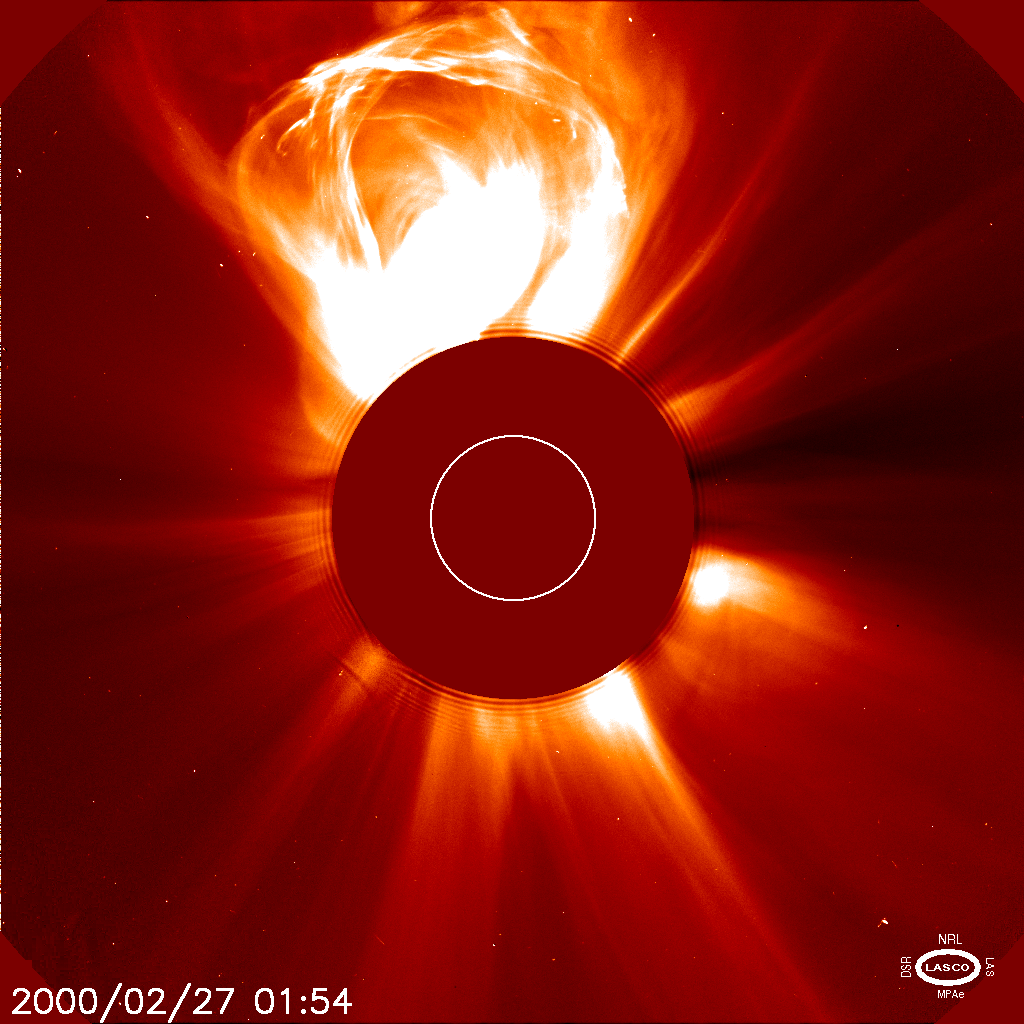
 We fear this kind of event when it is directly facing the Earth. Most of the time, it is observed by the technique of coronary angiography (above). That is to say that the solar disk cache to see what is happening around. Logically, therefore, can not see and the GCE oriented perpendicular to the axis Earth-Sun.
 But I was just telling you there is little the U.S. mission to observe the Sun STEREO. Two satellites observe the star from remote positions on the Earth's orbit around the Sun (the cons, satellite position STEREO January 31, 2011). It was therefore able to obtain images by the eruption of coronary directed toward Earth. They are:
In this video, the Earth is right, right in the path of this large CME happened to us in the mouth a few days later.
A neutron star full of superfluid
Two teams of researchers are keenly interested in Cassiopeia A, a supernova remnant located 11,000 light years from Earth in the constellation Cassiopeia. A massive star was there centuries ago. It exploded as a supernova about 330 years ago (as was yesterday), and the stellar corpse is a neutron star. Here is an image taken by NASA's Space Telescope Chandra X:

The stellar corpses have a feature in common: they are extremely dense. In a neutron star, the density and pressure are such that protons and electrons merge and form neutrons. A teaspoon of this substance (called "degenerate") weighs a few billion tons ...
The researchers observed a decrease in "brutal" (4% in 10 years) the temperature of the star. They sought to explain this cooling and reached the following conclusion: the heart of the neutron star must be made of matter "superfluid". Collapsing in on itself, the heart generates "neutrino" that escape from the star, taking with them the energy, and thus cool a bit. Ultra-dense matter that remains then behaves like a superfluid.
superfluid matter known on Earth, we know create it by experience, but under quite different cooling of matter near absolute zero (-273 °). Liquid helium is then in a state without any friction, and has remarkable properties: it is particularly capable of rising walls or escape from an enclosed ...
In the heart of the neutron star, it is far, far away from terrestrial conditions for producing superfluid ... The temperature is approaching the billion degrees. Under these conditions, the strong nuclear force (which binds the nucleons together to form the atomic nucleus) takes over. This
found no consequences in smacking practice, certainly, but it can better understand the behavior of matter degenerate (super heavy) and of superfluids ...
Kepler ISS
After a week of travel in orbit around the Earth, the European ATV cargo spacecraft named the second, named Johannes Kepler, docked Thursday at the International Space Station. As its name suggests, the Automated Transfer Vehicle has performed the operation automatically (under the anxious eyes of a hundred engineers, anyway). Most fans can relive that moment in video (caution, it lacks pace ...):
The ship's mission will last three months. His duties on board the ISS resupply, trash (and yes, it takes), and motor. Regularly, the large structure the ISS loses some altitude in its orbit, and it must improve. The ATC-2 reserve a little of its engines to give a boost when needed.
 Last takeoff for Discovery
 We seem to hear very regularly about the end of the space shuttle program U.S.. That's because Americans have a little trouble to abandon their ships, and eventually crack and re-sign for a spin. Discovery, which has already passed thirty missions since August 30, 1984, took off last Thursday when the ATV docked with the ISS.
STS-133 carries on the ISS Robonaut 2, final fantasy NASA: it is a humanoid robot (no legs) to be the first permanent member of the crew of the ISS. His role on board will assist astronauts in sensitive missions, including for spacewalks. It should reduce enormously the risk of casualties.
Halfway between horror and science fiction turnip, here's Robonaut. Go Robonaut, say hello to the readers.


0 comments:
Post a Comment