13.2 billion years. This is the time it took its light to reach us, and therefore also the age of the galaxy in question. By looking as far into space, the telescope in orbit a little pushes the limits of observation of the universe.

UDFj-39546284 could be simply the most distant celestial object ever observed: 13.2 billion light years. This tiny galaxy (there should be a hundred to get the mass of the Milky Way) was discovered in the Hubble Ultra Deep Field Infrared, an image of a rather special telescope.
Hubble Ultra Deep Field
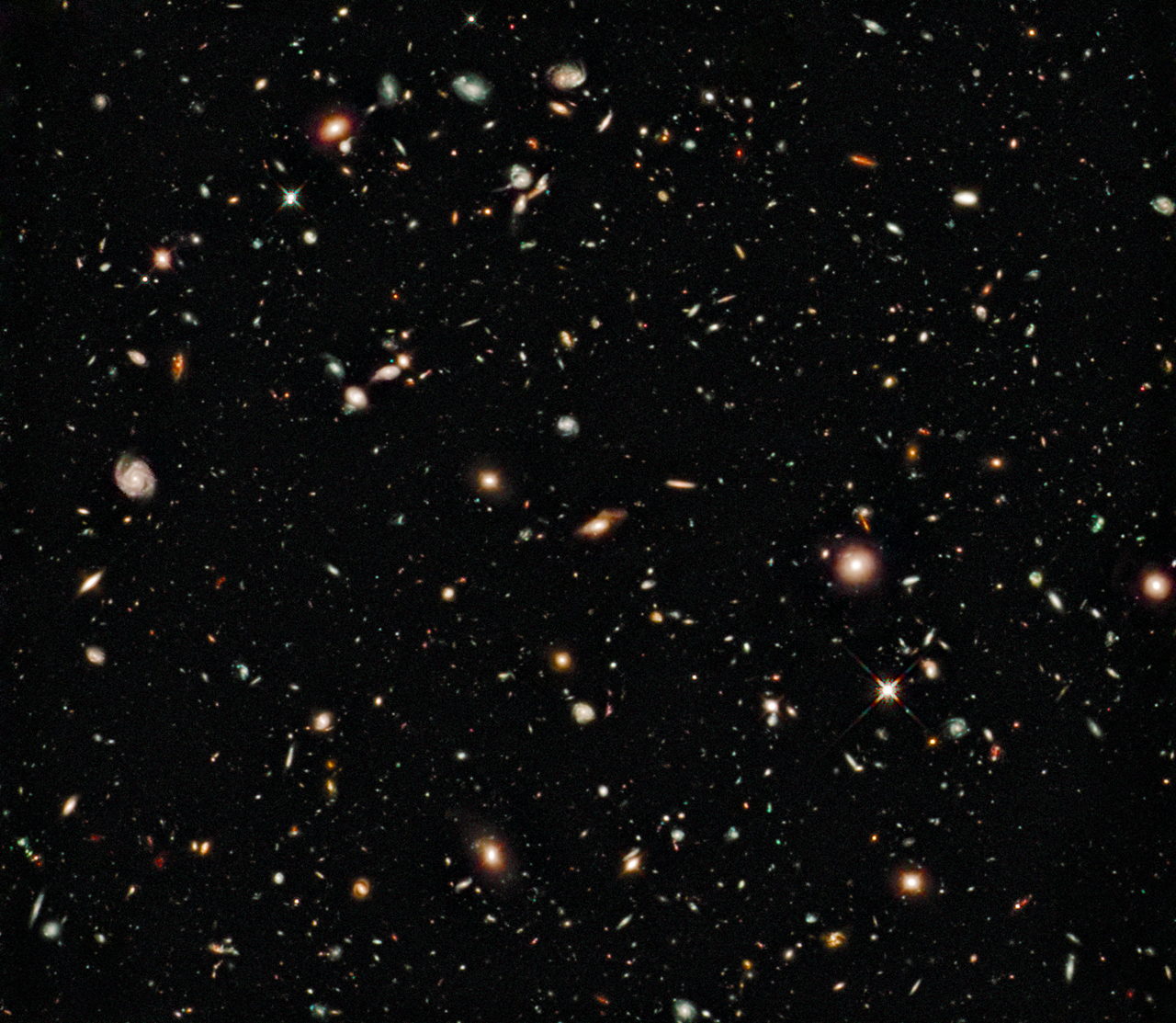
The image is worth to talk about it (click to enlarge). This is the version of the infrared background of this blog. The area of sky covered by this photograph is an ultra-precise rack of twenty seconds Bow side. The diameter of the Moon, it is worth about 30 arc minutes. The HUDF is almost 17 times smaller than the full Moon, and represents a treizmillionième (1 / 13 000 000) from the sky ... That's the kind of data that are staggering, and even more if you start counting the number of galaxies visible on the image (Not to mention the invisible galaxies here, including one that interests us today).
To achieve this level of detail, Hubble has established this area of the sky with a long, long time exposure: 48 full hours between 2009 and 2010! He obtained an image of an area that infrared had already observed with as much precision but in visible light in 2004 (wallpaper of this site).
UDFj-39546284
The galaxy of interest here is not one of those that appear at first glance. Quite the contrary, UDFj-39546284 is still invisible, or almost.

She appears on the image as a very dark, almost undetectable (red dot in the center of the image). This is explained by the phenomenon of redshift . Edwin Hubble (the astronomer, not the telescope) shows in the 20s, that the more distant galaxies are, the more quickly away from us. This is the "Hubble law".
We all know the Doppler effect when an ambulance passes at full speed in the street when approached, the sound of the siren is more acute and becomes more serious when the ambulance away. This effect of compression / decompression of sound waves to electromagnetic waves also apply: the redshift or redshift . The light from distant stars (which are receding from us at higher speeds) seems redshifted.
For UDFj-39546284, the redshift is such that the galaxy is more visible than infrared, the boundary of the spectrum detected by Hubble. The majority of the light it emits must lie below the infrared telescope but can not detect it.
The distance of the galaxy is also calculated with this phenomenon. It has been calculated UDFj-39546284 for a redshift of z = 10.3. Using models of cosmological expansion of the universe, scientists have deduced an age of 13.2 billion years. This data remains to be confirmed by additional measures.
Outbreak of creating stellar
This discovery tells us a lot about the early universe. According to the models, are expected not to find galaxies beyond 13.5 billion light years. The closer this limit, there is more things change ...
The brightness of a galaxy allows us to estimate the number of stars it contains. When comparing UDFJ-39546284 with galaxies between 13 billion years, we find that the rate of star formation has considerably increased between -13.2 and -13 billion years.
If you went back on time from now, we would see the rate of star formation increased gradually as they penetrate into the past. But somewhere between 480 and 600 million years after the Big Bang the trend reverses. We deduce that it took a few million years after the first training of galaxies to find a real leap of stellar creation.

Why? He will learn to wait for Hubble's successor, the James Webb Telescope, far more sensitive to infrared, which could see hundreds of these galaxies redshiftées to the extreme, invisible to Hubble.
Links
Discovery on the Hubble site: http:/ / hubblesite.org/newscenter/archive/releases/2011/05 /
James Webb Telescope Site: http://www.jwst.nasa.gov/index.html


0 comments:
Post a Comment